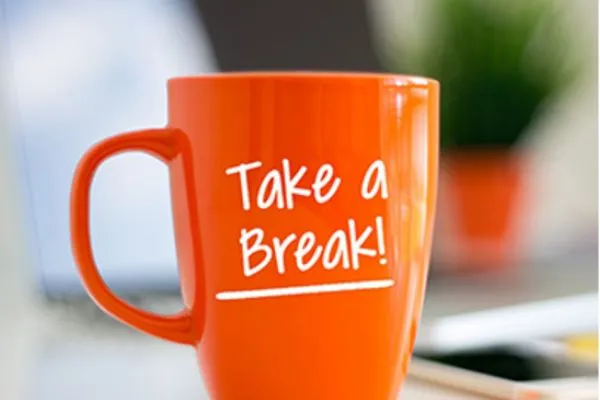
How Taking Breaks Can Improve Your Well-Being
Some people are terrible at taking breaks.
They eat lunch while answering emails. They work through headaches. They sit at the same desk for four hours and call scrolling through their phone for two minutes a “break.”
Then they wonder why they're exhausted by 3 p.m.
Your brain and body aren't designed to stay switched on every minute of the day.
Taking regular breaks can support your mental and physical well-being, especially when work, caregiving, or everyday responsibilities keep you under constant pressure.
You don't need an hour.
Sometimes five minutes is enough to interrupt the grind.
Why breaks matter
Think about what happens during a busy day.
You move from one task to another without stopping. Your shoulders creep toward your ears. Your eyes stay glued to a screen. Your thoughts jump between what you're doing now and the six things waiting afterward.
Eventually, your attention starts slipping.
You reread the same paragraph three times.
That's usually a pretty good sign that pushing harder isn't helping.
A short break gives you a chance to change position, move, rest your eyes, drink some water, or simply stop thinking about the task for a few minutes.
That's not laziness.
That's maintenance.
Breaks can give your brain a reset
Concentration isn't endless.
After working on the same task for a long time, you may notice yourself becoming distracted or mentally tired.
A short break can create separation between periods of focused work.
Stand up.
Walk around.
Look out a window.
Make some tea.
Then come back.
You may find that the problem that looked impossible 10 minutes ago feels a little less tangled.
Sometimes your brain needed space, not more pressure.
Breaks can help reduce everyday stress
Stress can build quietly.
One difficult email isn't always the problem.
It's the difficult email followed by a meeting, another deadline, six messages, skipped lunch, and two hours of sitting without moving.
By late afternoon, everything feels irritating.
Short breaks create small recovery points during the day.
Try taking a few slow breaths, walking outside, stretching, or sitting somewhere quiet.
The stressful situation may still exist afterward.
But you're giving yourself a chance to respond instead of staying wound up for hours.
Your body needs breaks from sitting
Mental breaks aren't the only kind that matter.
If your work involves long periods of sitting, get up regularly.
Walk to refill your water.
Stretch your legs.
Stand during a phone call.
Take the stairs when practical.
Even brief movement breaks can interrupt long stretches of sedentary time.
You don't need to turn every break into a workout.
Just move.
Give your eyes a break too
Hours of screen time can leave your eyes feeling tired, dry, or uncomfortable.
Looking away from your screen periodically can help.
One commonly suggested approach is the 20-20-20 rule: about every 20 minutes, look at something roughly 20 feet away for at least 20 seconds.
You don't have to set 24 alarms.
Just build the habit of looking away from your screen regularly.
And blink.
Seriously.
People tend to blink less when staring at screens.
A break can improve your mood
Have you ever spent hours fighting with a problem, finally walked away, and felt noticeably better five minutes later?
Nothing changed.
Except you stopped fighting with it.
A break can give you a little distance from frustration.
Go outside.
Listen to one song.
Talk to someone you like.
Make coffee.
Stretch.
Your mood doesn't have to become perfect.
Even moving from “I hate everything” to “Okay, I can finish this” is progress.
Not every break needs your phone
This is a big one.
You finish 45 minutes of focused work and immediately open social media.
Technically, you've stopped working.
But you've replaced one stream of information with another.
Notifications.
Videos.
News.
Messages.
Comments.
Your brain is still processing input.
Try taking at least some breaks without a screen.
Walk around the room.
Look outside.
Get water.
Close your eyes for a minute.
Let your brain experience something rare:
Nothing happening.
Take a real lunch break
Lunch eaten over your keyboard isn't much of a break.
When possible, step away from your workspace.
Sit somewhere else.
Eat your meal without answering emails.
If you have time, take a short walk afterward.
You don't need a 90-minute restaurant lunch.
Even 20 minutes away from your desk can create a useful separation in the middle of the day.
Try a five-minute movement break
If you've been sitting for a while, set a timer for five minutes.
Walk.
Do a few gentle stretches.
Roll your shoulders.
Move your neck comfortably.
Do a few chair squats if appropriate for you.
Then go back to what you were doing.
Five minutes can feel laughably small.
That's why it's easy to repeat.
Use breathing as a mini-break
Some days, you can't leave your desk.
You can still pause.
Sit comfortably.
Drop your shoulders.
Unclench your jaw.
Take a slow breath in and a comfortable, slightly longer breath out.
Repeat several times.
You don't need to call it meditation.
You're just giving your body a minute without another demand.
Take breaks before you're exhausted
This is where people get it backward.
They wait until they're completely drained before resting.
By that point, the break becomes damage control.
Try taking shorter breaks earlier.
For example, work with focus for a reasonable period, then step away for five minutes.
You may need different intervals depending on the task.
There isn't one perfect formula.
Pay attention to when your focus starts dropping.
That's useful information.
Build breaks into your calendar
If your day fills up quickly, don't rely on remembering to take breaks.
Schedule them.
You might block:
10:30 a.m.: Five-minute movement break
12:30 p.m.: Lunch away from the desk
3:00 p.m.: Ten-minute walk
It looks almost silly on a calendar.
Until you realize that without those blocks, you can easily sit down at 8:30 a.m. and barely move until dinner.
Breaks matter when working from home
Working from home can make boundaries even harder.
There isn't always a commute to separate work from personal life.
You can start answering email before breakfast and still be at your laptop after dinner.
Create transitions.
Take a walk before starting work.
Leave your workspace during lunch.
Close the laptop when the workday ends.
If possible, don't work from bed.
Your home shouldn't slowly become one giant office.
Breaks can help creative thinking
Sometimes the best way to solve a problem is to stop staring at it.
You've probably experienced this in the shower or while walking.
An idea suddenly appears.
Your brain didn't magically start working.
You simply gave it a different environment.
If you're stuck on a difficult problem, step away for a few minutes.
Don't use the break to keep thinking about the problem on another screen.
Give it space.
Rest isn't something you have to earn
This idea causes a lot of unnecessary exhaustion.
People tell themselves they'll rest when everything is finished.
But everything is never finished.
There's always another email.
Another load of laundry.
Another task.
Another person who needs something.
If rest only happens when the list is empty, you may never get much rest.
Take the break anyway.
What should you do during a break?
Keep it simple.
You can:
Walk outside
Stretch
Drink water
Eat a snack if you're hungry
Make tea
Take slow breaths
Talk with a friend
Sit quietly
Listen to music
Look away from your screen
Choose something that actually feels like a break.
If checking social media leaves you more irritated than before, that's probably not the recovery you needed.
Try this simple workday break routine
You don't need to redesign your schedule.
Start here.
Morning: Work for a focused period, then take five minutes to stand, stretch, or walk.
Lunch: Leave your workspace and eat without working when possible.
Afternoon: Take a 10-minute walk or movement break before your energy crashes.
End of work: Close the laptop, put work materials away, and create a clear transition into personal time.
That's enough to experiment with.
Don't turn breaks into another productivity trick
There's an odd trend of treating rest as useful only because it might help you work harder afterward.
That's missing the point.
Yes, breaks may help you return with better focus.
But you're also allowed to rest because you're a human being who gets tired.
Not every five minutes of your life needs to produce a measurable return.
When exhaustion needs more than a break
Regular breaks can help with everyday stress and fatigue.
They can't fix every cause of exhaustion.
If you're constantly tired despite adequate rest, or you're dealing with persistent anxiety, low mood, sleep problems, severe headaches, dizziness, shortness of breath, or other ongoing symptoms, talk with a healthcare professional.
Sometimes the problem isn't that you need another coffee break.
Something else needs attention.
Start with five minutes
You don't need to wait for vacation to recover.
Get up from your desk.
Stretch your legs.
Drink some water.
Look outside.
Take a few slow breaths.
Then come back when you're ready.
Five minutes may not look like much on your calendar.
But repeated throughout a busy week, those small pauses can help make the difference between constantly running on empty and giving yourself enough room to function like a person.
Take the break.
The work will still be there when you get back.